Cognition → Planning → Reflex
Public blueprint
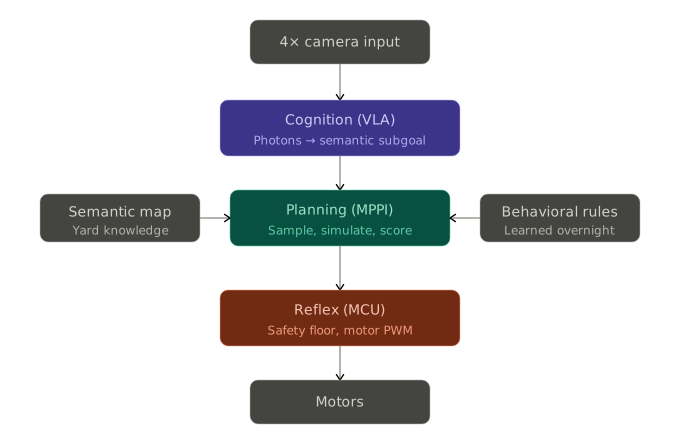
MPPI is now a first-class layer between cognition and reflex — not buried as an implementation detail inside the planner. That's the seam where the productivity-vs-safety tradeoff actually gets adjudicated. VLM → VLA: the cognition layer now emits actions/subgoals, not just descriptions — aligned with the current frontier (RT-2, OpenVLA, Pi-Zero). Semantic map and behavioral rules are shown explicitly as cost-function inputs to MPPI — the architectural seam where the differentiation from the training walk pays off. The v0.1 four-tier framing (L1–L4 + reflection) collapses to a cleaner three runtime tiers + a separate offline learning loop on its own temporal layer.
System diagram · runtime
Tier-by-tier
Jetson Orin · vision-language-action class (RT-2, OpenVLA, Gemini Robotics-ER)
Jetson Orin or NUC) · sampling-based MPC
Meta · offline temporal layer
Validation plan in progress. Before any on-yard trials, the cognition tier gets staged validation: an on-device latency + decision-quality baseline on the Jetson Orin (Qwen2.5-VL class model, real yard photos), then closed-loop software-in-the-loop in NVIDIA Isaac Sim with domain randomization, paired with a real-image holdout to guard against the sim-to-real appearance gap. Companion deep-dive page (VLDN-01 · "proving the stack") forthcoming once the on-device baseline is in.
Trace · Kitchen Errand
[traverse hallway → enter kitchen → wait for button-press → return via reverse path]. Emit first subgoal to Planning: target_region=kitchen_entry, constraints=[avoid_furniture].